Buying an AC sounds simple until you have to choose between 1 ton and 1.5 ton.
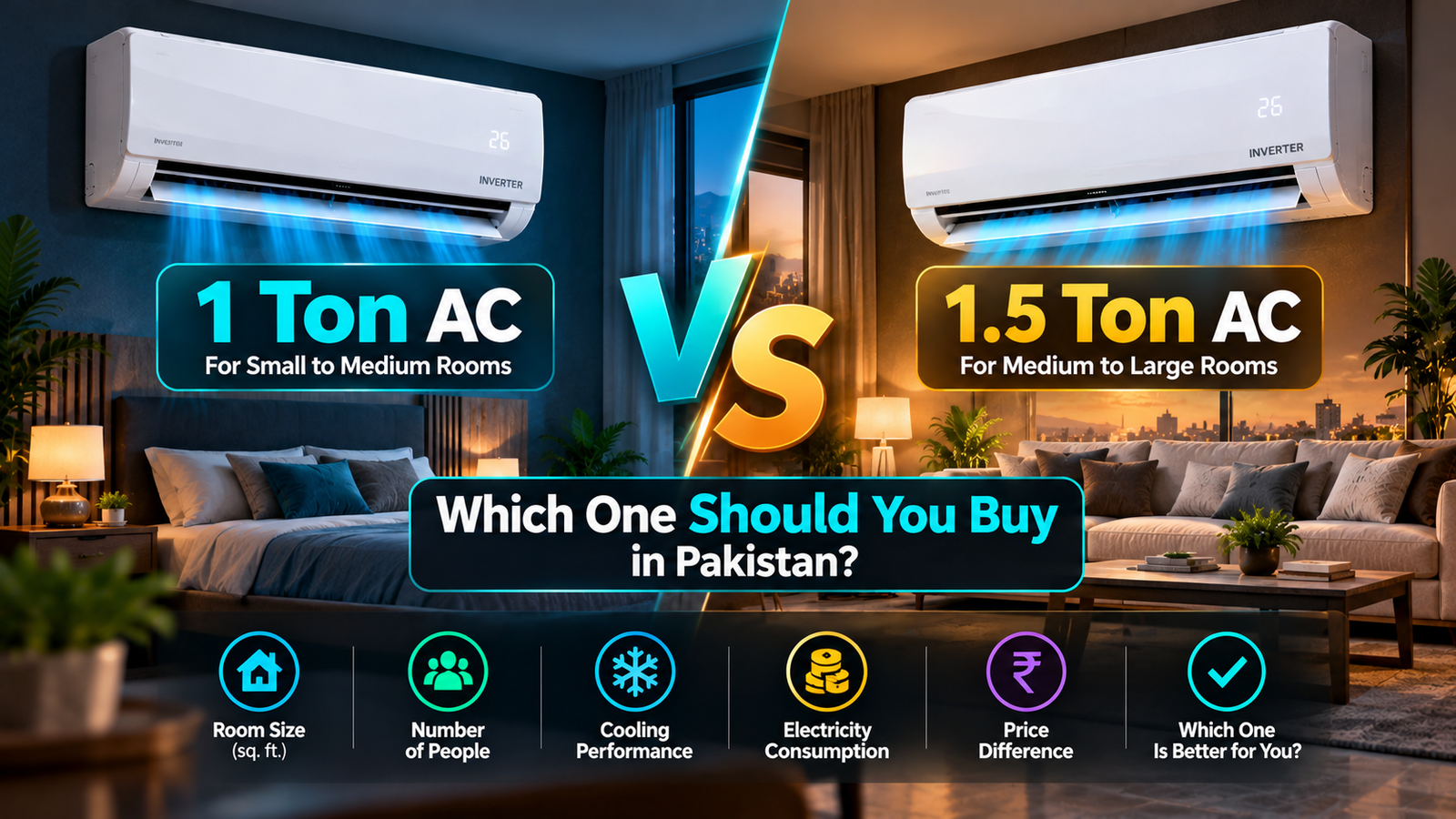
A 1-ton AC can be a very good choice for a normal bedroom, while a 1.5-ton AC makes more sense for a larger bedroom, living room, or a room that gets a lot of heat.
But there is one important thing to remember: bigger does not always mean better.
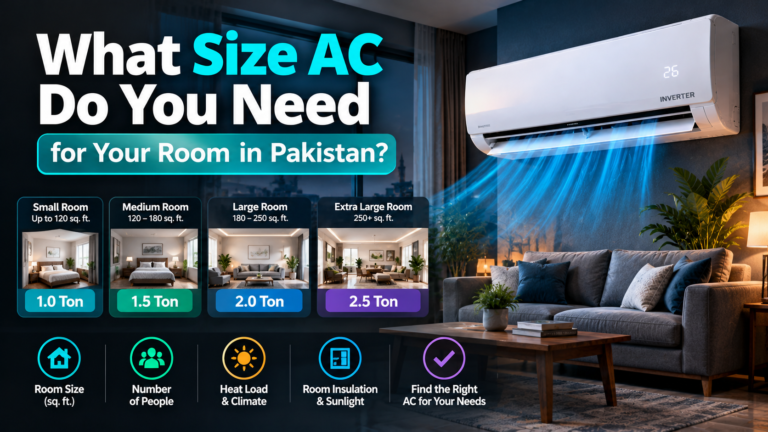
The right AC depends on your room size, sunlight, ceiling height, insulation, windows, number of people and overall heat load.
In this guide, we’ll explain the difference between 1 ton and 1.5 ton ACs and then look at some actual models available in Pakistan, so you can go from deciding the right capacity to choosing the right AC.
Quick Answer: 1 Ton or 1.5 Ton AC?
For a small or normal-sized bedroom, a good 1-ton inverter AC is often enough.
For a larger bedroom, living room or high-heat room, 1.5 ton is generally the safer choice.
| Room Situation | Usually Consider |
| Small bedroom | 1 Ton |
| Normal bedroom | 1 Ton |
| Large bedroom | 1.5 Ton |
| Living room | 1.5 Ton |
| Large living room / hall | 2 Ton or higher |
| Top-floor or very sunny room | Consider higher capacity |
These are starting points, not fixed rules. A 12×12 room with strong afternoon sunlight can have a very different cooling requirement from a shaded, well-insulated 12×12 room.
What Does 1 Ton or 1.5 Ton Mean?
The “ton” of an AC does not refer to its weight. It refers to its cooling capacity.
As a general reference:
- 1 Ton ≈ 12,000 BTU/hour
- 1.5 Ton ≈ 18,000 BTU/hour
Actual AC models can have somewhat different rated capacities. Some modern 1-ton models are rated above 12,000 BTU, while some 1.5-ton models are rated above 18,000 BTU.
So when comparing models, don’t look at the tonnage alone. The actual cooling capacity and manufacturer’s specifications also matter.
1 Ton vs 1.5 Ton AC: What’s the Difference?
The simple difference is cooling capacity.
A 1.5-ton AC can remove more heat than a 1-ton AC, which is why it is normally used for larger or hotter spaces.
| Feature | 1 Ton | 1.5 Ton |
| Cooling capacity | Lower | Higher |
| Typical use | Bedrooms / smaller rooms | Larger bedrooms / living rooms |
| Purchase price | Usually lower | Usually higher |
| Suitable for large rooms | Limited | Better suited |
| Small room | Often a good fit | May be unnecessary |
One common misconception is that a 1.5-ton AC will always consume 50% more electricity than a 1-ton AC.
That’s not how it works.
Actual electricity consumption depends on the AC model, efficiency, compressor operation, room heat load, outdoor temperature and your temperature setting.
Is 1 Ton Enough for Your Room?
For many normal bedrooms, yes.
A room around 10×12 ft or 12×12 ft may be suitable for a 1-ton inverter AC, depending on its conditions.
But room dimensions are only part of the story.
A 1-ton AC may have a harder job if the room:
- is on the top floor
- receives strong afternoon sunlight
- has large windows
- has poor insulation
- has a higher ceiling
- normally has several people inside
This is why you shouldn’t blindly follow a rule such as “1 ton is always enough for X square feet.”
When Does 1.5 Ton Make More Sense?
A 1.5-ton AC becomes more attractive when the room is larger or has a higher cooling load.
It can be a better choice for:
- large bedrooms
- master bedrooms
- living rooms
- top-floor rooms
- rooms with strong sunlight
- rooms with large windows
- spaces used by several people
If a 1-ton AC is already close to its limit, moving to 1.5 ton can be more sensible than making a smaller AC work continuously during the hottest part of summer.
What About Electricity Consumption?
If you’re trying to reduce your electricity bill, don’t simply buy the smallest AC available.
An undersized AC can struggle to maintain the desired temperature and may need to run for longer periods.
At the same time, installing a much larger AC in a small room is not automatically more efficient either.
The goal is proper sizing.
Inverter ACs can also adjust compressor output according to the cooling requirement, which is why the actual electricity consumption of two ACs with different tonnages can be closer than you might expect.
For a fair comparison, look at the actual model’s power input and efficiency rather than judging only by 1 ton vs 1.5 ton.
Does a 1.5 Ton AC Cool Faster?
It has a higher cooling capacity, so it can remove heat at a higher rate when operating at the required output.
But that doesn’t mean you should put a 1.5-ton AC in every small bedroom.
For a properly sized room, a 1-ton inverter can provide very comfortable cooling without the need for extra capacity.
The objective is not simply to cool the room as quickly as possible. It is to cool it comfortably and efficiently.
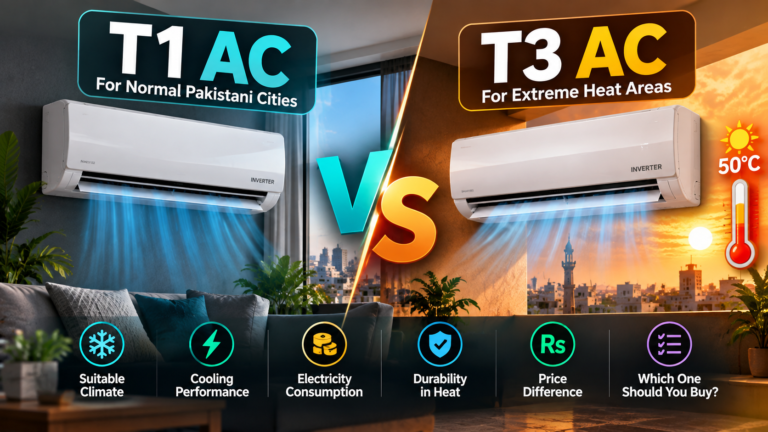
T1 vs T3 AC: Do You Need T3?
T3 ACs are designed for hotter operating conditions and can be useful when the outdoor temperature and room heat load are particularly high.
But not every Pakistani home needs a T3 AC.
For a normal bedroom with reasonable insulation and no extreme heat load, a standard inverter AC can be a perfectly sensible choice.
T3 becomes more interesting when you have:
- a very hot room
- a top-floor location
- strong direct sunlight
- poor insulation
- a high cooling requirement
So don’t pay extra for T3 just because it sounds like the more powerful option. Look at your actual room first.
AC Models Worth Considering in Pakistan
Once you’ve decided on the required tonnage, the next question is: which AC should you buy?
Here are some models worth considering. Prices can change because of promotions, stock and retailer differences, so check the final price before purchasing.
1. Dawlance Cruise Plus Inverter — 1 Ton
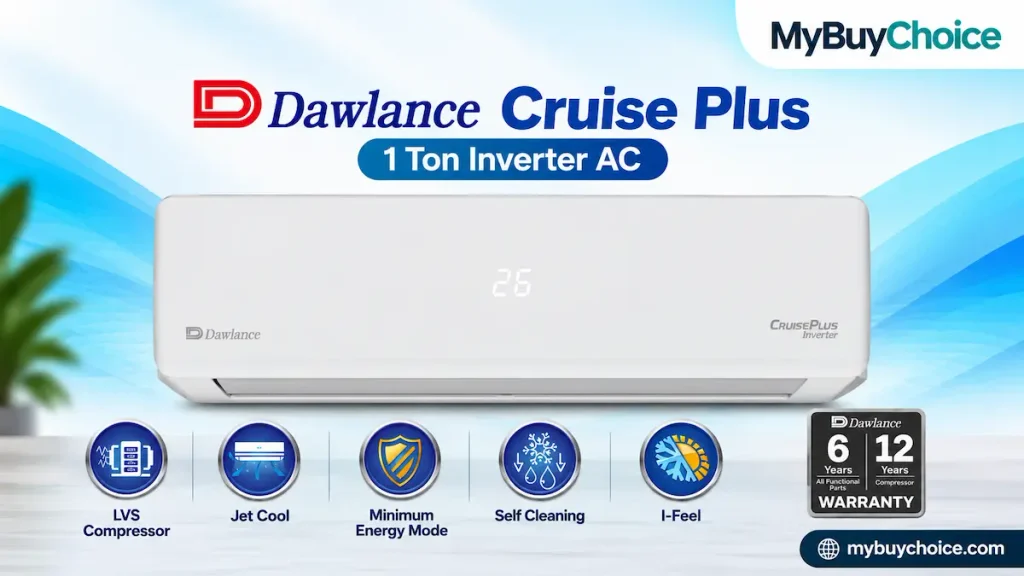
Best for: Normal bedrooms and budget-conscious buyers.
Current listed price: Around Rs. 107,000
If your room is in the normal bedroom range and doesn’t have an unusually high heat load, this is the kind of 1-ton inverter worth considering.
Key point: A straightforward option for buyers who don’t need a high-capacity or premium AC.
Quick specs
Type: Inverter Split AC
Capacity: 1 Ton / 12,000 BTU
Compressor: DC Inverter + LVS
Energy Efficiency: 3.01 W/W
Self Cleaning: Yes
Modes: Cool + Heat, Sleep Mode
Warranty: 12 years compressor + 6 years functional parts
2. Haier – Turbo Cool Series – HSU-12CFCP – 1 Ton AC
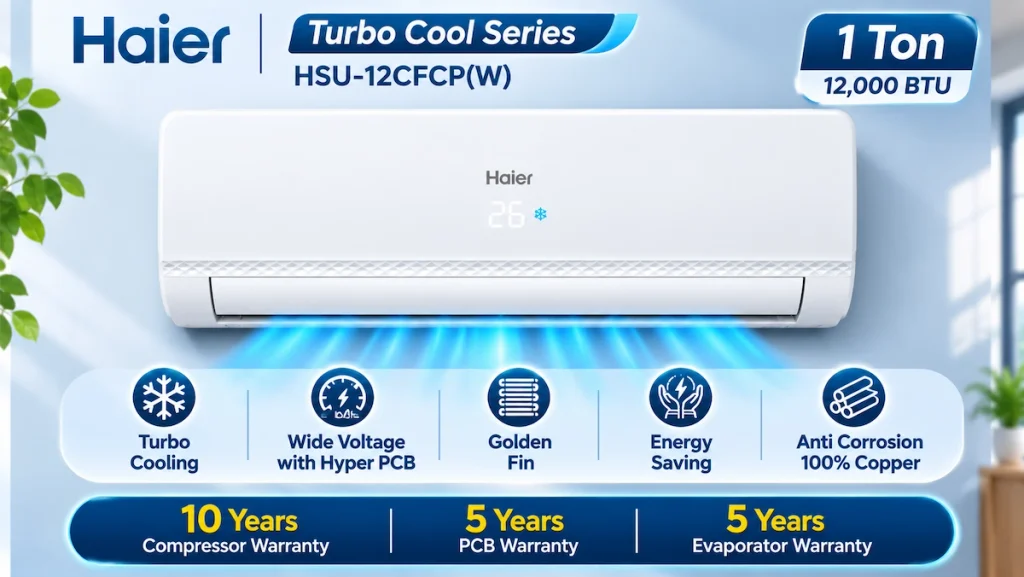
Best for: Normal bedrooms and buyers who prefer Haier.
Current listed price: Around Rs. 91,999
Haier has several 1-ton Non-Inverter options in Pakistan, including standard and T3 models. For an ordinary bedroom, you don’t necessarily need to jump to the more expensive T3 range.
Key point: A good brand to compare when shopping in the 1-ton category.
Quick specs
Type: Non-Inverter
Capacity: 1 Ton
Cooling: ~12,000 BTU
Cooling Type: Cool Only
Refrigerant: R-32
Running Current: 5.5A
3. PEL InverterOn ATOM — 1 Ton
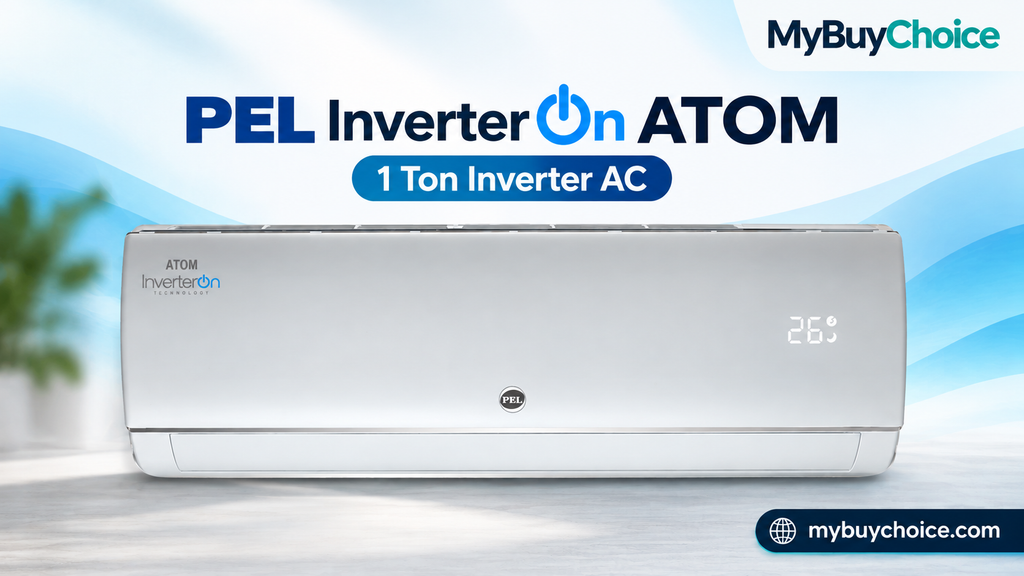
Best for: Buyers looking for a budget-friendly inverter AC.
Current listed starting price: Around Rs. 110,900
The InverterOn ATOM is one of the more affordable options worth checking for a normal room.
Key point: Particularly interesting if keeping the initial purchase price low is important.
Quick specs
Type: Inverter Split AC
Capacity: 1 Ton / 12,000 BTU
Operation: Heat & Cool
Refrigerant: R32
3-Stage Ampere Lock: Yes
Extreme Heat: Designed for reliable cooling in high temperatures
Warranty: 10 years compressor + 5 years PCB + 5 years parts
4. Dawlance EnerCon X T3 Inverter — 1 Ton
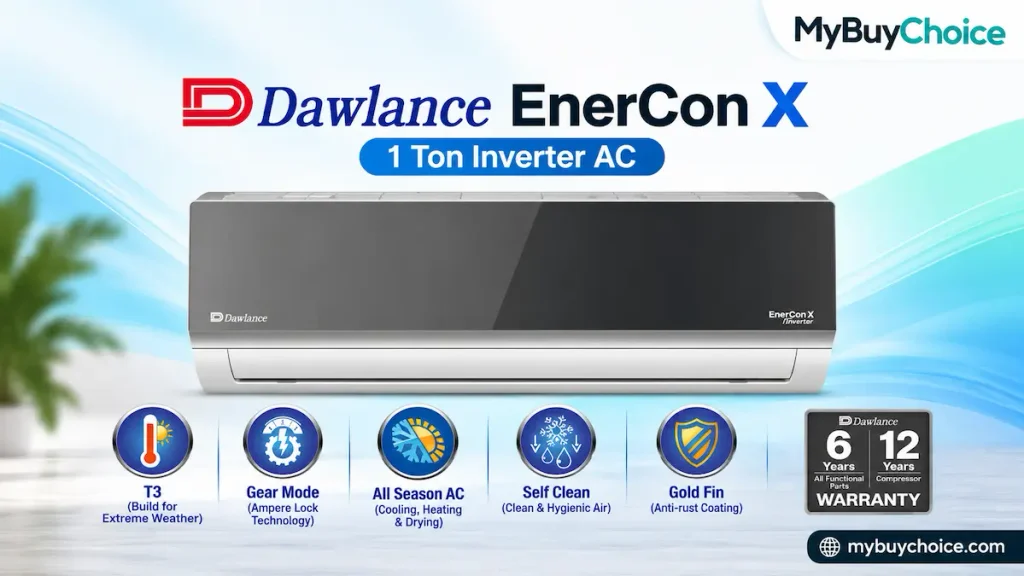
Best for: Hot, top-floor or high-heat rooms.
Current listed price: Around Rs. 133,000
This is the type of 1-ton T3 model that makes more sense when your room regularly deals with high heat.
For a normal bedroom, you may not need to spend extra on T3.
Key point: Consider it when heat is the reason you’re worried about a standard 1-ton AC.
Quick specs
Type: Inverter Split AC
Capacity: 1 Ton / 12,000 BTU
Cooling Current: 5A
Heat & Cool: Yes
T3: Yes
Self Cleaning: Yes
Warranty: 12 years compressor + 6 years functional parts
5. Dawlance Cruise Plus Inverter — 1.5 Ton
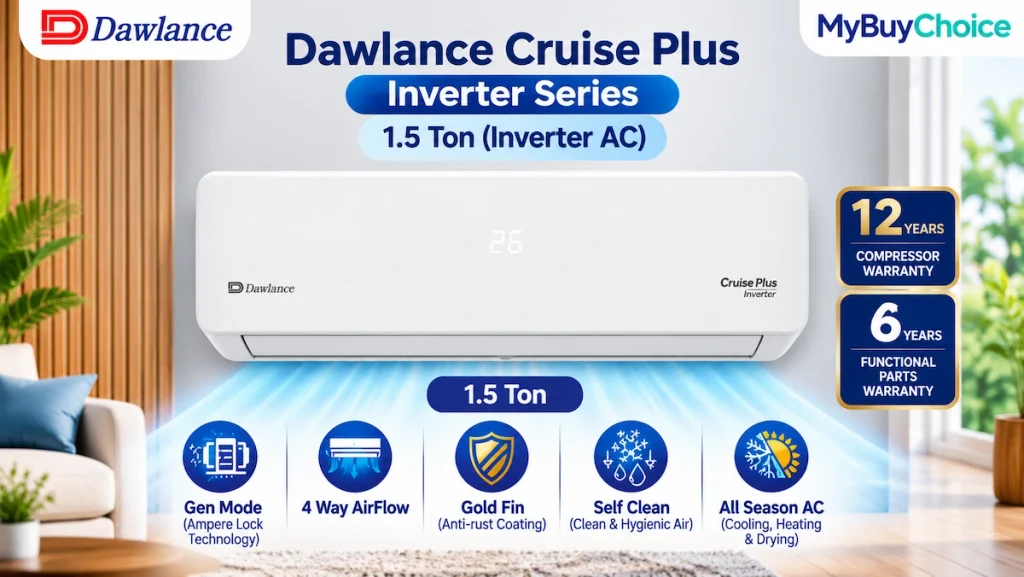
Best for: Larger bedrooms and medium-size living rooms.
Current listed price: Around Rs. 123,000
If you’ve already determined that 1 ton is too small for your room, this is one of the more affordable 1.5-ton options to compare.
Key point: A practical choice when you need more cooling capacity without moving too far up the price range.
Quick specs
Type: Inverter Split AC
Capacity: 1.5 Ton / 18,000 BTU
Compressor: DC Inverter + LVS
Refrigerant: R32
Heat & Cool: Yes
Self Cleaning: Yes
Filters: 2 High-Density Filters
Warranty: 12 years compressor + 6 years functional parts
6. Dawlance EnerCon X T3 Inverter — 1.5 Ton
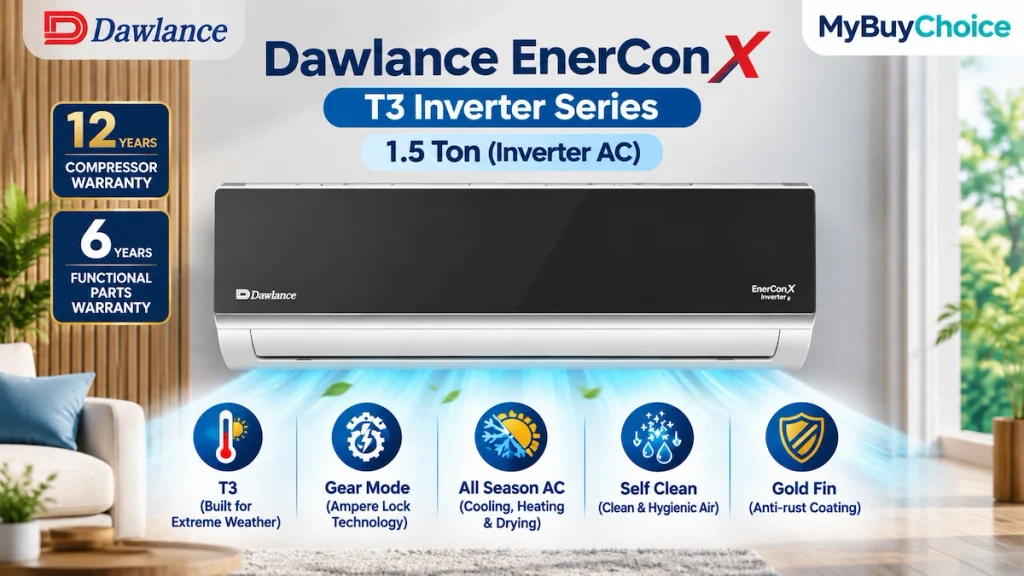
Best for: Larger rooms with high heat load.
Current listed price: Around Rs. 154,000
This is a more relevant choice if your room is large, receives strong sunlight, is on the top floor or regularly gets very hot during summer.
For a normal room, a standard 1.5-ton inverter may be enough.
Key point: A 1.5-ton T3 option for buyers who actually need the additional hot-weather capability.
Quick specs
Type: Inverter Split AC
Capacity: 1.5 Ton / 18,000 BTU
Compressor: Rotary Inverter + LVS
Refrigerant: R32
T3: Yes
Heat & Cool: Yes
Low Voltage Operation: Yes
Self Cleaning: Yes
Warranty: 12 years compressor + 6 years functional parts
7. Dawlance Elegance X — 2 Ton
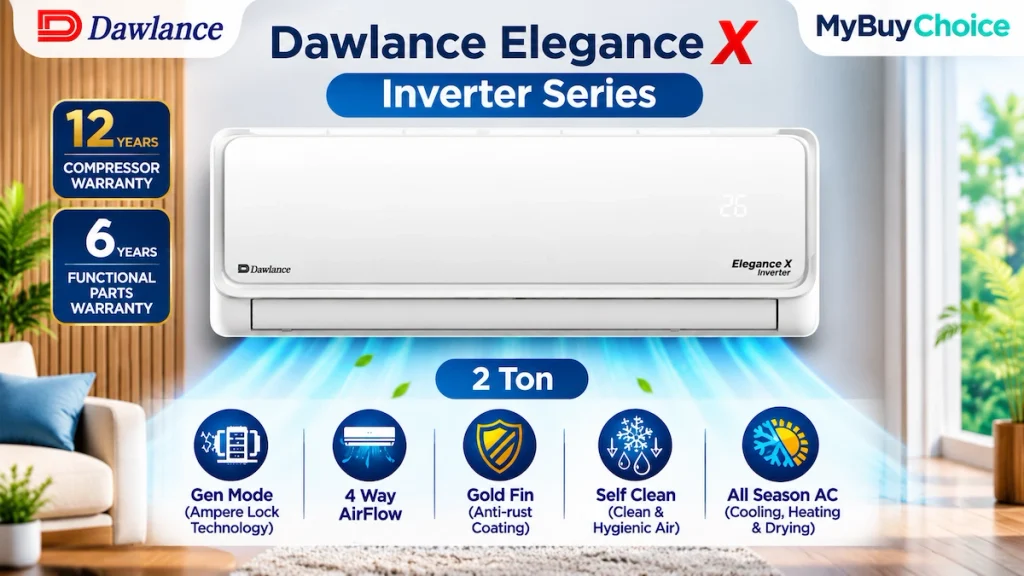
Best for: Large living rooms and halls.
Current listed price: Around Rs. 185,999
A 2-ton AC is not necessary just because you want faster cooling. It becomes relevant when the space itself has a genuinely high cooling requirement.
For a normal bedroom, this would usually be overkill.
Key point: Consider it only when your room or hall is large enough to justify the extra capacity.
Quick specs
Type: Inverter Split AC
Capacity: 2 Ton / 18,000 BTU
Compressor: Rotary Inverter + LVS
Refrigerant: R32
Heat & Cool: Yes
Low Voltage Operation: Yes
Self Cleaning: Yes
Warranty: 12 years compressor + 6 years functional parts
Which AC Should You Buy?
If you want to keep the decision simple:
Choose 1 Ton if:
- You have a small or normal-sized bedroom
- The room has reasonable insulation
- Sunlight isn’t extreme
- You don’t have a particularly high heat load
- You want to keep the purchase price lower
Choose 1.5 Ton if:
- You have a large bedroom
- You have a master bedroom with higher cooling requirements
- You’re cooling a living room
- The room receives strong sunlight
- You’re on the top floor
- A 1-ton AC is likely to be undersized
Consider 2 Ton if:
- You have a large living room
- You have a hall or large open space
- The cooling load is genuinely high
1 Ton vs 1.5 Ton for a Bedroom
For a normal bedroom, don’t buy 1.5 ton simply because it has more cooling power.
A properly sized 1-ton inverter can be a very sensible choice.
For a large master bedroom, especially one on the top floor or exposed to strong sunlight, 1.5 ton may be the better option.
The right capacity is more important than simply choosing the bigger number.
1 Ton vs 1.5 Ton for a Living Room
Living rooms usually have more people, larger windows and more frequent movement in and out of the room.
That’s why 1.5 ton often becomes more attractive for a medium or larger living room.
A small living room may still work well with 1 ton, depending on its heat load.
What Should You Check Before Buying?
Before placing your order, check these points:
1. Capacity
Make sure the tonnage matches the room.
2. Inverter technology
For regular daily use, an inverter AC is generally the better category to consider.
3. Heat load
Think about sunlight, top floor, windows and insulation.
4. T1/T3 requirement
Don’t pay extra for T3 unless your room actually benefits from it.
5. Warranty
Check compressor and parts warranty for the exact model.
6. After-sales service
Service availability matters, especially during peak summer.
7. Installation cost
Check what is included and whether extra copper pipe, brackets or other material will cost more.
8. Voltage/backup compatibility
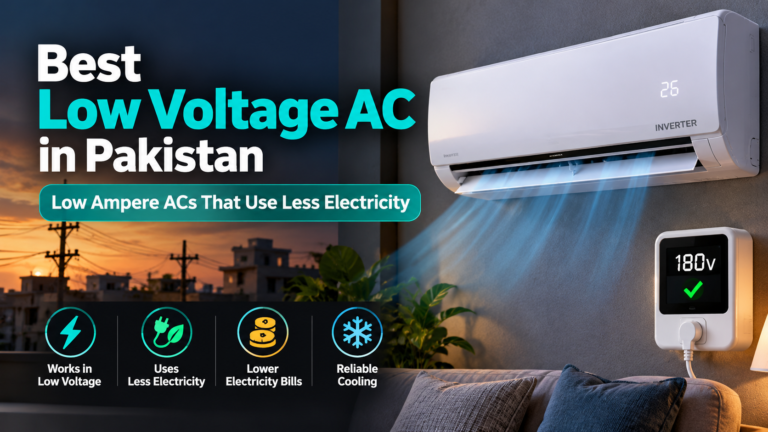
If you use solar, UPS or experience voltage fluctuations, check the model’s operating range before buying.
Frequently Asked Questions
Is 1 ton AC enough for a bedroom?
For many normal-sized bedrooms, yes. But sunlight, insulation, top-floor location and other heat-load factors can change the requirement.
Is 1.5 ton better than 1 ton?
Not automatically. It has more cooling capacity, but the better AC is the one that matches your room.
Does a 1.5 ton AC use more electricity?
It can consume more power when operating at higher output, but actual consumption depends on the model and cooling conditions.
Can I use a 1.5 ton AC in a 12×12 room?
Yes, but it may not be necessary for a normal 12×12 bedroom. A properly sized 1-ton inverter may be sufficient unless the room has a high heat load.
Is T3 AC necessary in Pakistan?
No. T3 can be useful for particularly hot or high-load conditions, but a suitable standard inverter can be enough for many normal rooms.
Which is better for a top-floor room?
It depends on the room size and heat load. A top-floor room often needs more cooling capacity, especially when the roof receives strong sunlight.
Which is better for a living room: 1 ton or 1.5 ton?
For a small living room, 1 ton may work. For a medium or larger living room, 1.5 ton is generally worth considering.
Final Verdict
If you’re buying an AC for a normal bedroom, start by looking at good 1-ton inverter models.
If you have a larger bedroom, living room or higher heat load, 1.5 ton is usually the more practical direction.
For a large hall or open living space, you may need 2 ton or another appropriately sized capacity.
The biggest mistake is choosing an AC simply because it has the highest tonnage or the lowest price.
Instead, start with your room.
Small/normal bedroom → 1 Ton
Large bedroom/living room → 1.5 Ton
Large hall/high cooling load → 2 Ton or properly sized higher capacity
Once you’ve decided the tonnage, compare the actual models on price, efficiency, warranty, service and overall value.
That’s a much better way to buy an AC than simply choosing the biggest model your budget allows.
Quick Buying Checklist
Before you buy, ask yourself:
- What is my room size?
- Is it a bedroom or living room?
- Is it on the top floor?
- How much direct sunlight does it get?
- How many people normally use it?
- Do I actually need T3?
- Is the AC an inverter?
- What is its actual cooling capacity?
- What warranty does the manufacturer provide?
- What is included in installation?
- Is the price competitive with similar models?
If you can answer these questions, the choice between 1 ton and 1.5 ton becomes much easier.