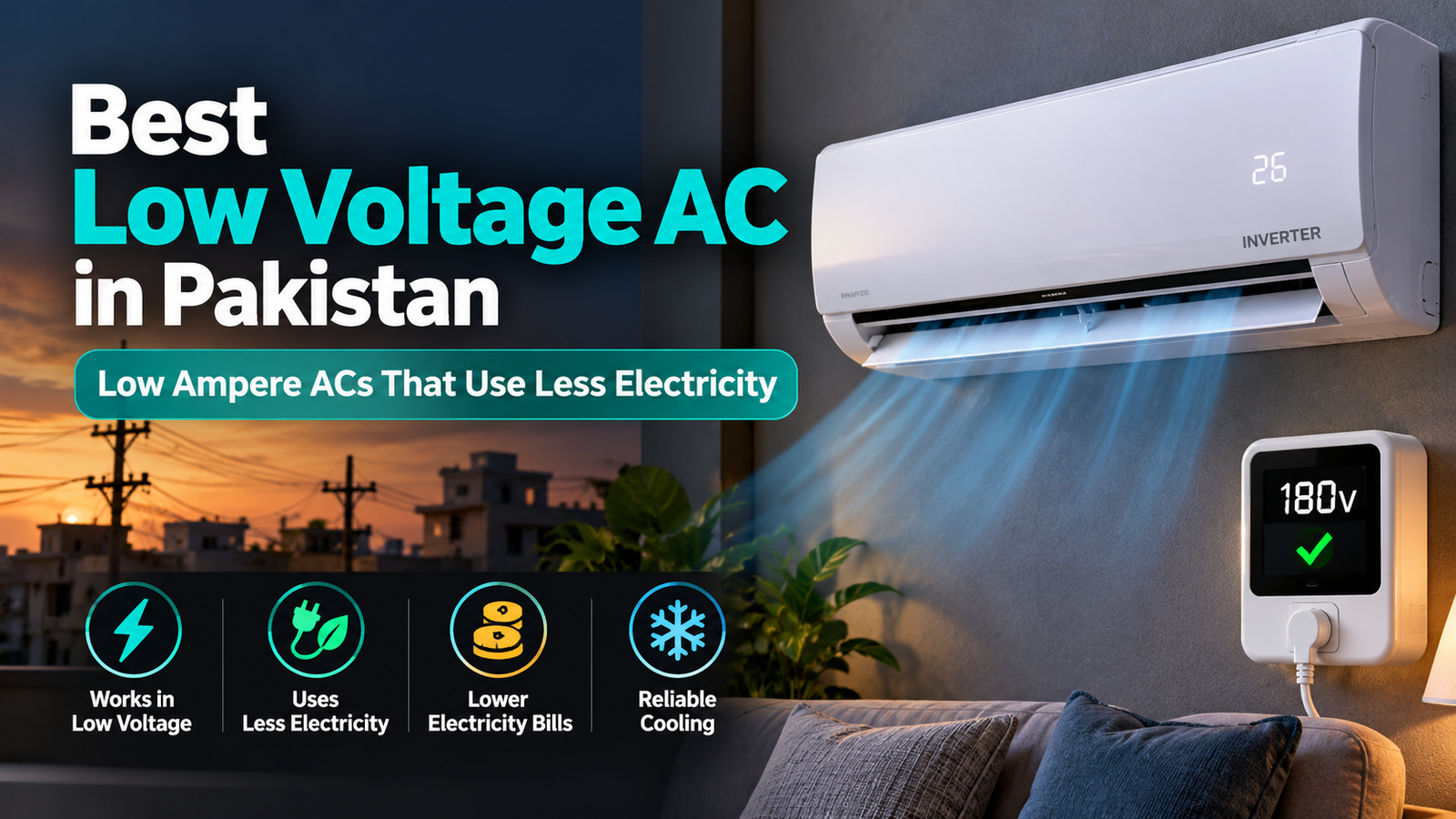
When buying an AC in Pakistan, cooling performance and price are not the only things that matter. Electricity bills are also a major concern. That is why many people search for terms like “best low voltage AC in Pakistan,” “low ampere AC,” or “AC that uses less electricity.”
However, there is one important point to understand: a low-voltage AC and a low-electricity-consumption AC are not exactly the same thing.
If your main goal is to reduce your electricity bill, you should look for an inverter AC that can operate efficiently at lower power, intelligently adjust compressor speed, and reduce power consumption once the room reaches the desired temperature.
In this guide, we look at four ACs — two 1-ton and two 1.5-ton models — with a focus on lower electricity consumption.
Quick Answer: Which AC Is Better for Lower Electricity Bills?
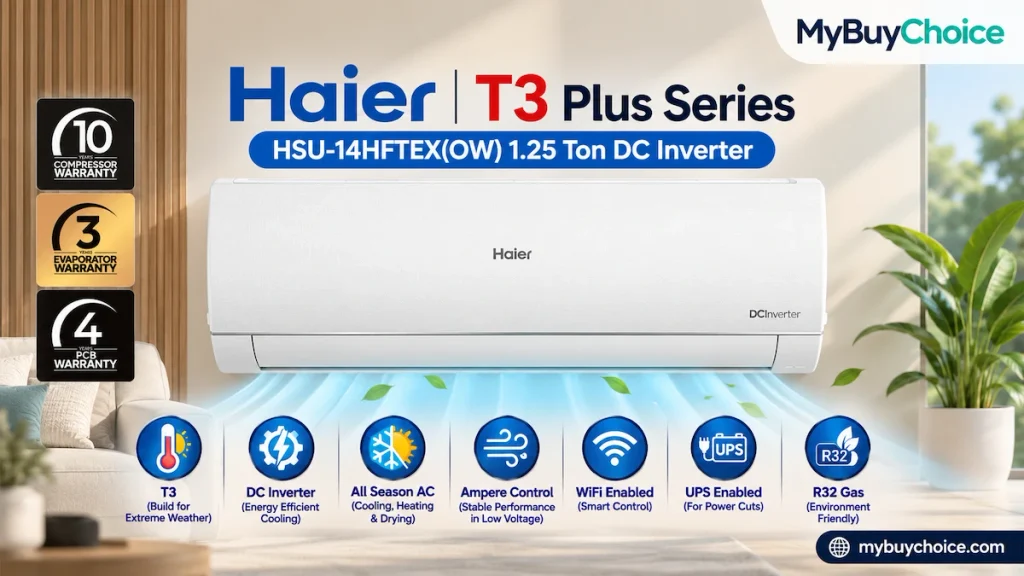
If you need an AC for a small to medium-sized bedroom, the Haier HSU-14HFTEX 1.25 Ton T3 Plus is one of the strongest options on our shortlist. According to Haier’s official specifications, its cooling power input is 0.36–1.19 kW, while its operating current is 1.6–5.3A. Haier also advertises a 1.2A energy-saving mode for this model.
For the 1.5-ton category, the Haier HSU-20HFTEX T3 Plus is another interesting option, with a published cooling power input of 0.52–1.85 kW.
However, your final decision should not be based only on the ampere rating. Room size, sunlight, insulation, and the actual cooling load can have a significant impact on electricity consumption.
What Does “Low Voltage AC” Actually Mean?
In Pakistan, the term “low voltage AC” can be used to describe two different things.
First: an AC that can operate safely when the home’s supply voltage is relatively low.
Second: an AC that uses less current and power, resulting in lower electricity consumption.
In this article, we are mainly focusing on the second meaning, because reducing electricity bills is a major concern for AC buyers.
However, if your home has frequent voltage fluctuations, you should also check the AC’s operating voltage range and voltage-protection features. Some inverter models are designed to operate within a wider voltage range.
Should You Judge an AC by Its Ampere Rating?
Many buyers assume:
“This AC runs at 1.2 amps, so it must have the lowest electricity bill.”
That conclusion is not always correct.
An inverter AC does not normally consume a fixed amount of current. When the room is very hot, the compressor may need more power. Once the room reaches the desired temperature, the inverter can reduce compressor speed and power consumption.
That is why you should consider several specifications when comparing ACs:
- Minimum power input
- Rated/normal power input
- Maximum power input
- Operating current range
- Inverter technology
- Energy-saving/ECO modes
- Cooling capacity
- Correct tonnage for your room
For example, the Haier HSU-14HFTEX has a published cooling input range of 0.36–1.19 kW and a current range of 1.6–5.3A.
These figures help us understand the AC’s operating range, but actual monthly electricity consumption will vary from one home to another.
4 Best Low Electricity Consumption ACs in Pakistan
1. Haier HSU-14HFTEX 1.25 Ton T3 Plus
Best for: Small to medium-sized bedrooms
If your main goal is lower electricity consumption in a 1.25-ton AC, this model is one of the strongest options on our shortlist.
According to Haier’s official specifications, the model has a cooling power input of 0.36–1.19 kW and an operating current range of 1.6–5.3A. It also features a T3 compressor, Wi-Fi, ECO mode, and self-cleaning. Haier also mentions 1.2A energy-saving operation, but this should not be interpreted as the AC consuming a fixed 1.2A during normal full-load cooling. It is related to a specific operating mode/condition.
- Cooling capacity: 14,500 BTU
- Power input: 0.36–1.19 kW
- Current: 1.6–5.3A
- Type: T3 DC Inverter
- Refrigerant: R32
- Price: 142,000
Why consider it: Its low published power range, T3 compressor, and combination of efficiency and cooling make it a strong 1-ton option.
2. Haier HSU-13HFC 1 Ton Triple Inverter
Best for: Buyers looking for a 1-ton AC with low-power inverter operation
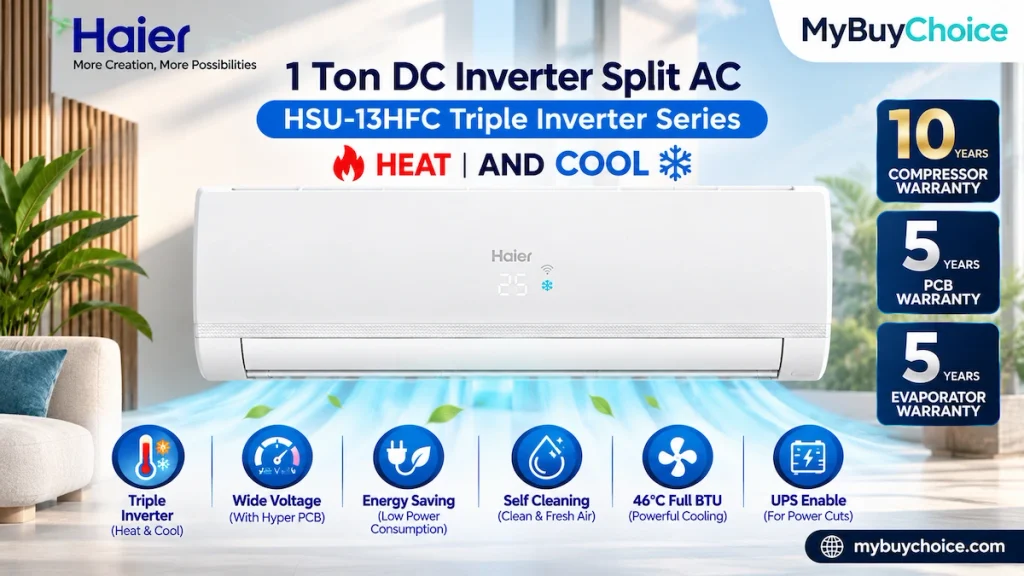
Haier’s Triple Inverter model is another interesting option. According to its official specifications, the cooling power input is 0.36–1.39 kW, while the operating current range is 1.6–6.5A. The model also includes AI ECO, a 1.2A energy-saving feature, Wi-Fi, self-cleaning, and UPS operation.
- Cooling capacity: 13,300 BTU
- Power input: 0.36–1.39 kW
- Current: 1.6–6.5A
- Type: DC Triple Inverter
- Refrigerant: R32
- Price: 115,000
Its minimum published power input is the same as the HSU-14HFTEX, although its maximum input is slightly higher. Therefore, I would not automatically call it more efficient than the HSU-14HFTEX.
3. Haier HSU-20HFTEX 1.5 Ton T3 Plus
Best for: Medium to larger rooms where a 1.5-ton AC is required
If your room genuinely requires a 1.5-ton AC and electricity consumption is an important consideration, the HSU-20HFTEX is a strong option.
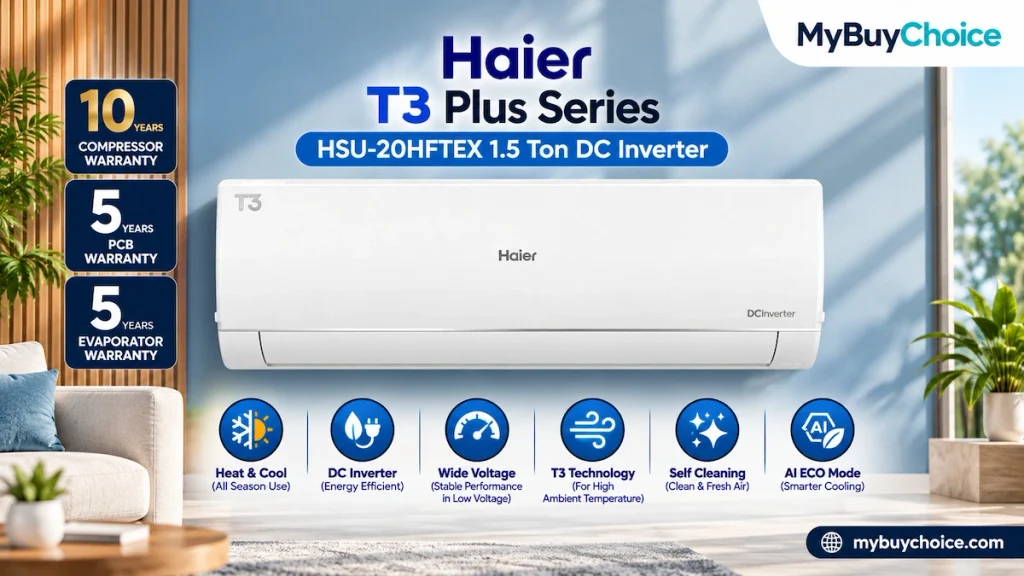
Its published cooling power input is 0.52–1.85 kW, while its operating current range is 2.3–8.1A. The T3 compressor is listed with full-BTU cooling capability up to 53°C, while the model also includes a 1.2A energy-saving mode.
- Cooling capacity: 21,000 BTU
- Power input: 0.52–1.85 kW
- Current: 2.3–8.1A
- Type: T3 Plus DC Inverter
- Refrigerant: R32
- Price: 184,000
A 1.5-ton AC can naturally consume more power than a 1-ton model. However, if your room actually needs 1.5 tons of cooling capacity, choosing an undersized 1-ton AC simply to save electricity is not necessarily a good strategy.
4. Haier HSU-19HFC 1.5 Ton Triple Inverter
Best for: Buyers looking for a more affordable 1.5-ton energy-saving option
The HSU-19HFCS is another interesting option for buyers looking for efficient inverter operation. Haier’s official specifications list a cooling power input of 0.52–1.89 kW and an operating current range of 2.3–8.3A. It also includes a 1.2A energy-saving feature, ECO mode, Wi-Fi, and UPS operation.
- Cooling capacity: 19,000 BTU
- Power input: 0.52–1.89 kW
- Current: 2.3–8.3A
- Type: DC Triple Inverter
- Refrigerant: R32
- Price: 140,000
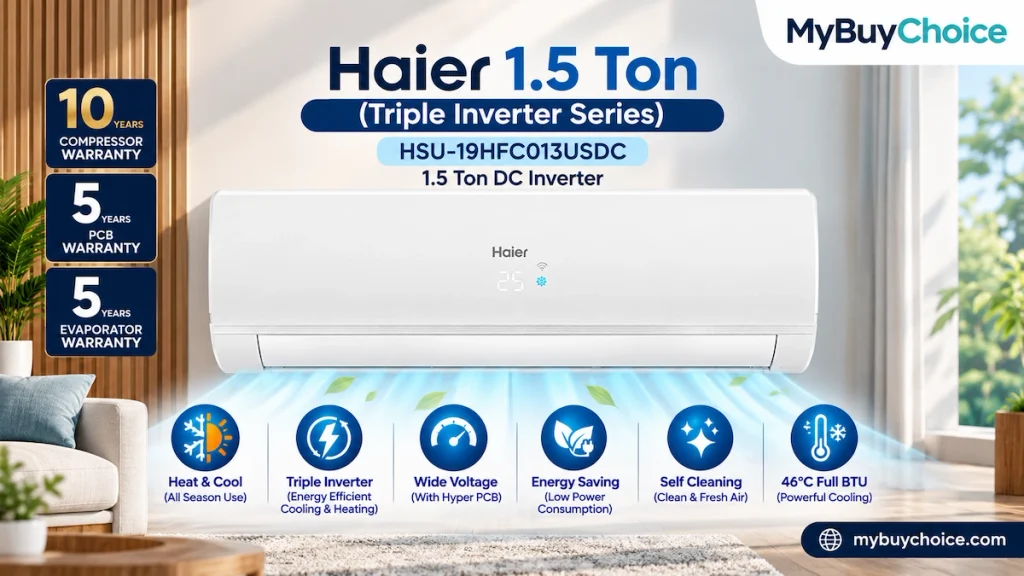
Its maximum published power input is slightly higher than the HSU-20HFTEX, but its market price can be considerably lower.
Does a 1.2-Amp AC Always Consume Only 1.2 Amps?
No.
This is one of the most important points AC buyers should understand.
Haier mentions 1.2A energy-saving operation on some of its models. However, this does not mean that the AC will continuously consume only 1.2A.
According to Haier’s explanation, 1.2A operation is associated with specific conditions and energy-saving/dehumidification operation. During normal cooling, current consumption changes according to room temperature, cooling demand, and compressor operation.
Therefore, it would not be technically accurate to simply call an AC a “1.2A AC” and claim that it will always have the lowest electricity bill.
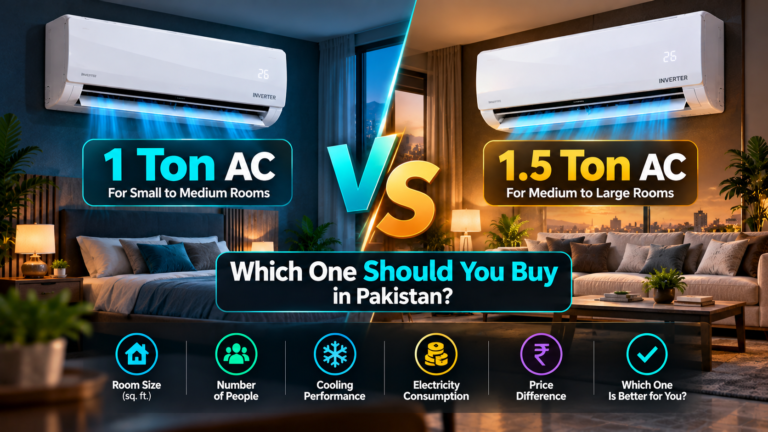
Should You Buy a 1 Ton or 1.5 Ton AC for Lower Bills?
It depends on your room.
If your room only requires a 1-ton AC, buying a 1.5-ton model does not automatically mean a lower electricity bill.
At the same time, if your room requires 1.5 tons of cooling capacity, choosing a 1-ton AC just to save money can also be a poor strategy. An undersized AC may have to work harder and run for longer periods to maintain the desired temperature.
So the sensible approach is:
First choose the correct tonnage. Then choose an efficient inverter AC within that tonnage.
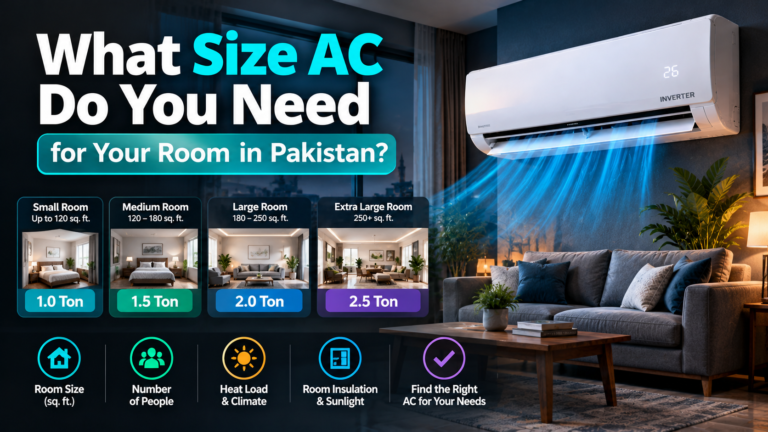
If you are unsure whether your room needs 1 ton or 1.5 tons, our [AC Size for Room Guide] can help.
Your Electricity Bill Does Not Depend Only on the AC
The same AC can consume very different amounts of electricity in two different homes.
For example:
- Top-floor room = higher heat load
- Direct sunlight = higher cooling demand
- Poor insulation = compressor may run longer
- Frequently opened doors = cooling loss
- Setting the AC at 18°C = generally higher workload
- Setting it around 25–26°C = generally lower workload
That is why simply saying “this AC runs at 1 amp” does not provide an accurate prediction of your monthly electricity bill.
5 Practical Ways to Reduce Your AC Electricity Bill
1. Keep the Temperature Around 24–26°C
Instead of unnecessarily setting the AC to 18°C, using a moderate temperature can help reduce electricity consumption.
2. Keep the Room Properly Sealed
If cool air continuously escapes through doors or windows, even an efficient AC will need to work harder.
3. Reduce Direct Sunlight
Curtains or blinds, especially on sunny windows, can help reduce the heat entering the room.
4. Use ECO Mode
When maximum cooling is not necessary, ECO or energy-saving modes can be useful.
5. Choose the Correct Tonnage
This is one of the most important factors.
A low-bill AC is not simply an AC with a low ampere rating. The right-sized and efficient inverter AC is a much more sensible approach.
Final Verdict
If you are searching for the “best low voltage AC in Pakistan” but your actual goal is lower electricity consumption and lower running costs, do not choose an AC based only on its ampere rating.
Our four-model shortlist is:
1.25 Ton:
Haier HSU-14HFTEX 1.25 Ton T3 Plus — our first choice because of its low published power range and strong overall efficiency-focused specifications.
1 Ton Alternative:
Haier HSU-13HFC Triple Inverter — a lower-priced alternative with a 1.2A energy-saving feature.
1.5 Ton:
Haier HSU-20HFTEX T3 Plus — a higher-capacity option with strong efficiency-focused specifications.
1.5 Ton Alternative:
Haier HSU-19HFC Triple Inverter — a comparatively budget-friendly option.
The most important point is this: an AC’s electricity bill is not determined by ampere rating alone. Actual power consumption, cooling load, usage hours, room conditions, and temperature settings all matter.
If your goal is to reduce your electricity bill, first choose the correct tonnage, then look for an efficient inverter, and finally compare the power and current specifications.