If you are buying an AC in Pakistan, you have probably come across terms like T1 and T3.
For many buyers, T3 sounds like the obvious choice because Pakistan gets extremely hot in summer. But does every home actually need a T3 AC?
Not necessarily.
The difference between T1 and T3 is mainly about the temperature conditions in which the AC is designed to operate. Your room, local climate and usage pattern should decide whether paying extra for T3 is worthwhile.
T1 vs T3 AC: Quick Answer
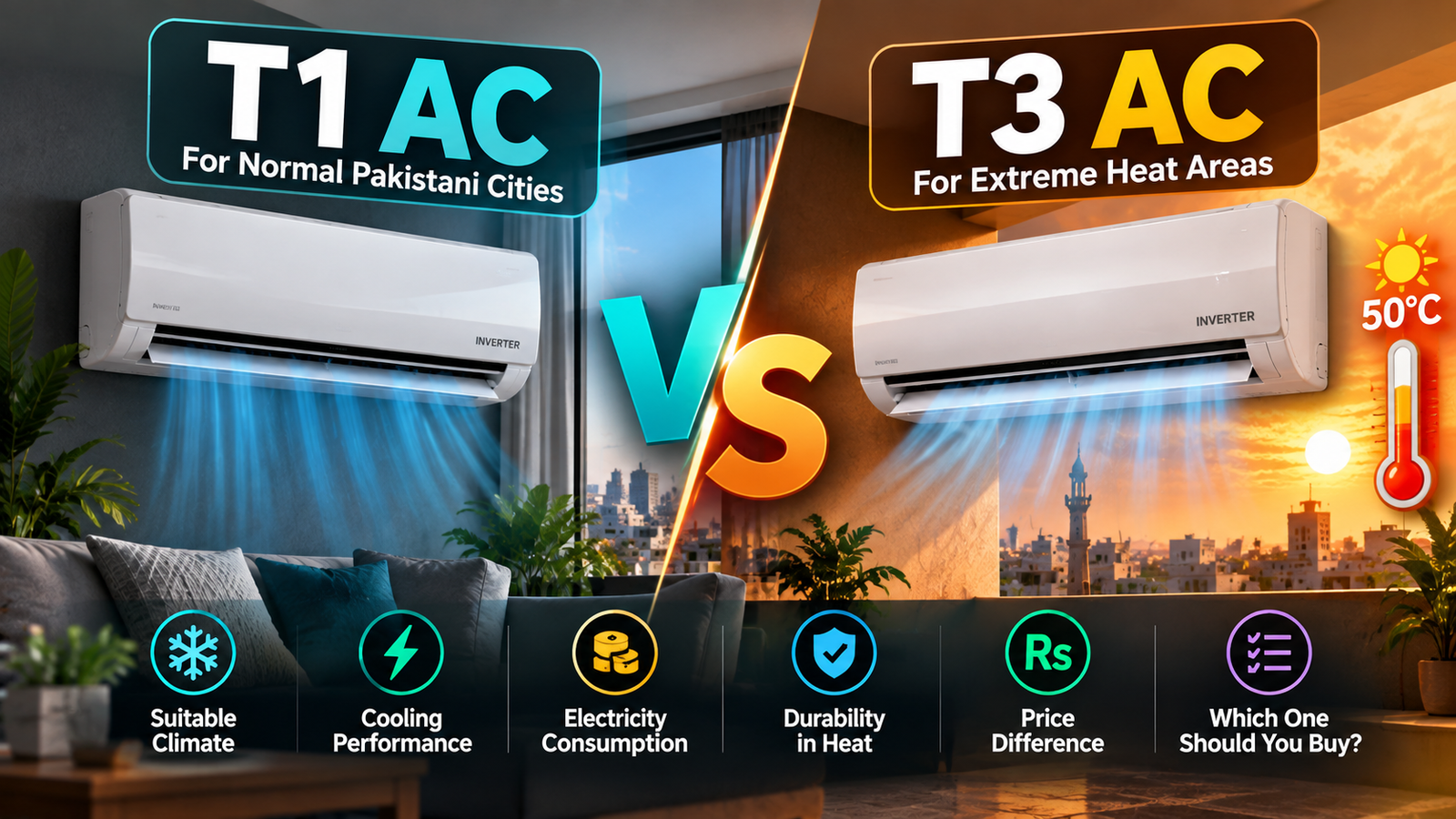
T1 is generally intended for normal operating conditions, while T3 is designed for hotter ambient conditions.
That doesn’t mean T3 is automatically the better choice. A properly selected T1 inverter can be perfectly practical for many normal rooms, while T3 becomes more useful when the AC has to deal with higher heat.
| T1 AC | T3 AC | |
| Designed for | Normal conditions | Hotter conditions |
| Typical use | Normal residential use | High-heat environments |
| Price | Usually lower | Usually higher |
| Best suited to | Normal rooms | Hot/high-load rooms |
| Automatically better? | No | No |
What Do T1 and T3 Temperature Ratings Mean?
Under the ISO 5151 testing standard, T1 ACs are rated under an outdoor temperature condition of 35°C, while T3 ACs are tested under a much hotter outdoor condition of 46°C.
This helps explain why T3 models are designed for demanding hot-weather conditions. However, these figures are standard testing conditions, not strict operating limits. A T1 AC does not automatically stop working above 35°C, and actual performance depends on the specific model.
What Is a T1 AC?
T1 is a classification related to the operating temperature conditions of an air conditioner.
It is important not to confuse T1 with tonnage.
For example:
- 1 Ton T1 = 1-ton cooling capacity + T1 classification
- 1.5 Ton T1 = 1.5-ton cooling capacity + T1 classification
T1 does not mean the AC is weak or unsuitable for Pakistan.
If your room has normal conditions and the AC is correctly sized, a good T1 inverter can be a practical choice.
1 Ton T1 Example
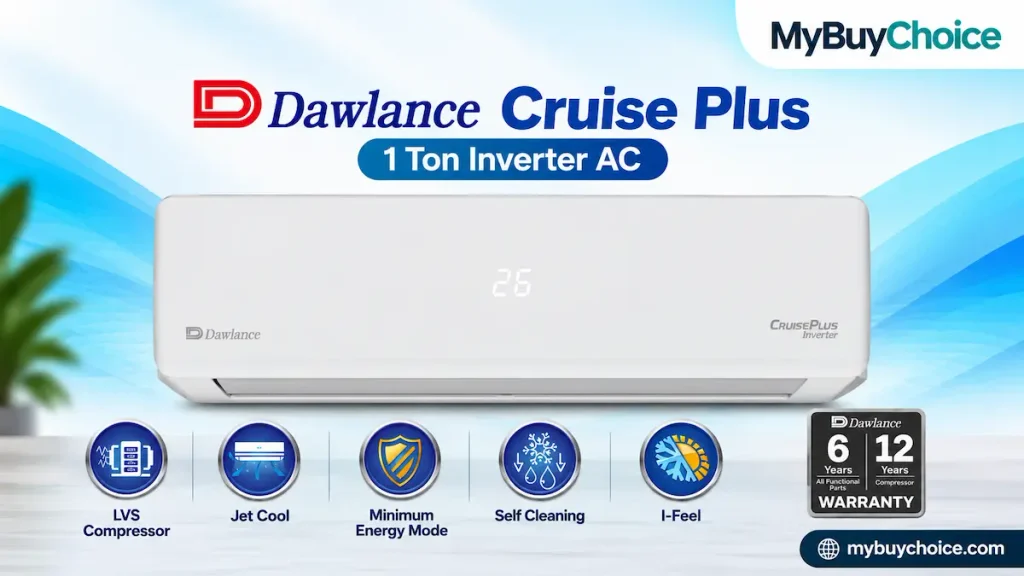
Dawlance Cruise Plus Inverter — 1 Ton
Best for: Normal bedrooms
- Cooling Capacity: 12,000 BTU/h
- Compressor: DC Inverter
- Cooling Current: 5.3A (Rated)
- Cooling Efficiency: 3.01 W/W
- Function: Heat & Cool
- Indoor & Outdoor Fan Motors: DC
- Price: Around Rs. 107,000
1.5 Ton T1 Example
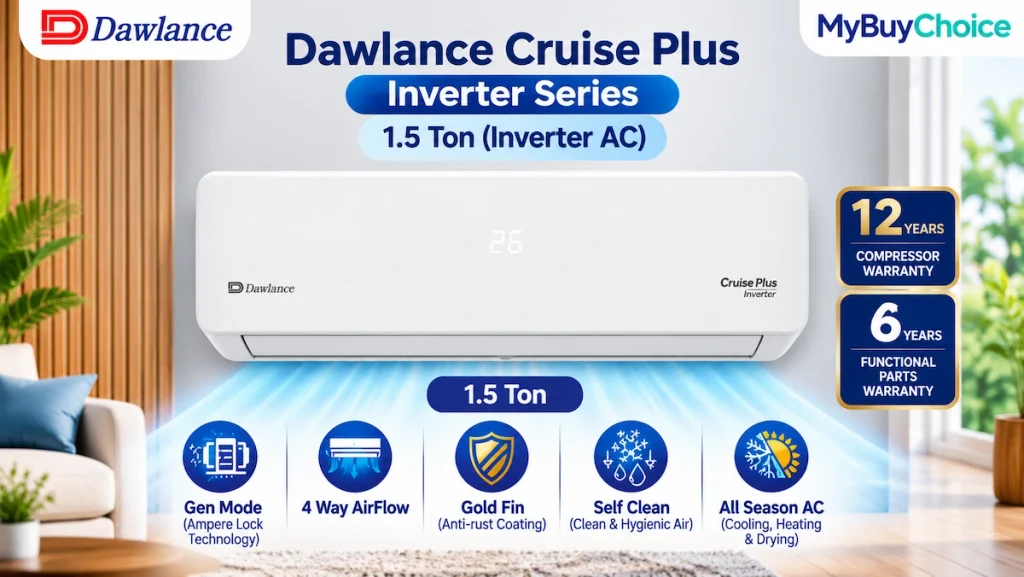
Dawlance Cruise Plus Inverter — 1.5 Ton
Best for: Larger bedrooms and normal living rooms
- Cooling Capacity: 18,000 BTU/h
- Heating Capacity: 18,000 BTU/h
- Compressor: DC Inverter
- Cooling Current: 8A (Rated)
- Cooling Efficiency: 3.01 W/W
- Function: Heat & Cool
- Indoor & Outdoor Fan Motors: DC
- Minimum Energy Mode: Yes
- Price: Around Rs. 123,000
What Is a T3 AC?
T3 ACs are designed to operate under higher ambient temperature conditions.
This is where T3 becomes particularly interesting for Pakistani buyers.
Imagine a room directly under a hot roof, receiving strong afternoon sunlight and becoming extremely hot during summer. The AC has a much tougher job in that environment than it would in a shaded, well-insulated room.
That’s where a T3 model can make more sense.
1 Ton T3 Example
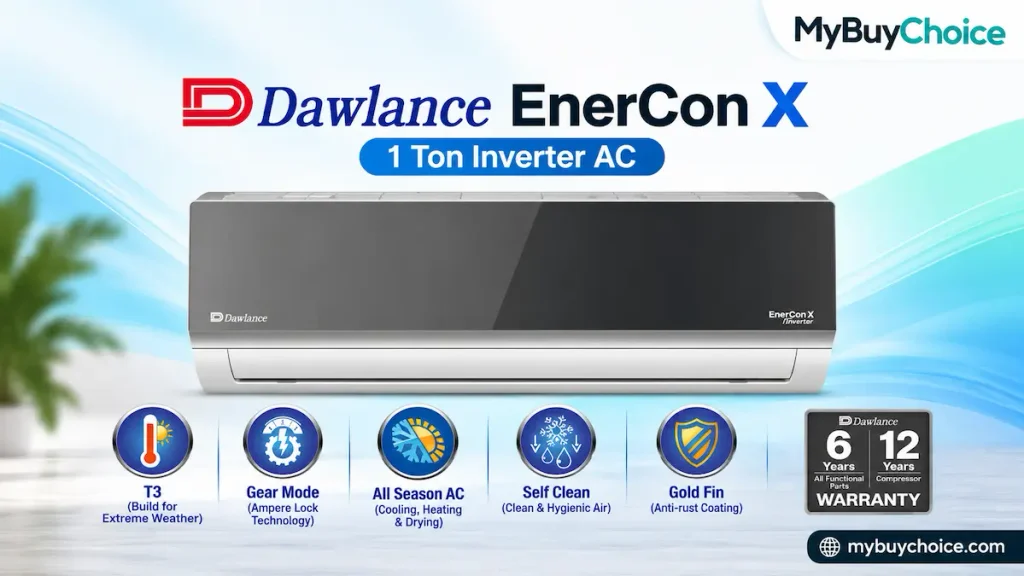
Dawlance EnerCon X T3 Inverter — 1 Ton
Best for: Hot bedrooms and demanding summer conditions
- Key specs:
- Capacity: 1 Ton
- Cooling: 12,000 BTU/h
- Compressor: T3 + LVS
- Efficiency: 3.21 W/W
- Refrigerant: R32
- Price: Around Rs. 133,000
1.5 Ton T3 Example
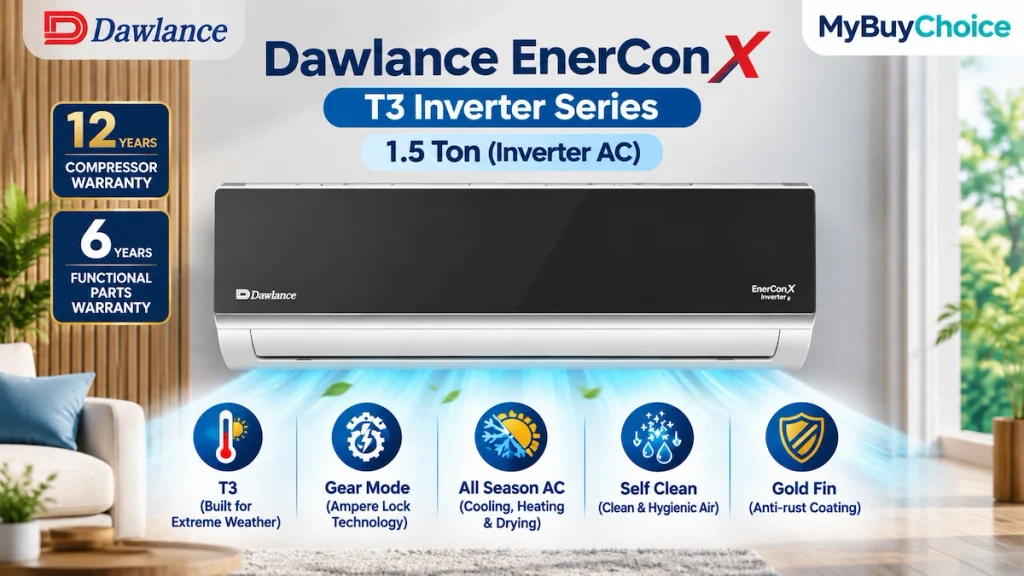
Dawlance EnerCon X T3 Inverter — 1.5 Ton
Best for: Larger rooms with higher heat load
- Key Specs
- Cooling Capacity: 18,000 BTU/h
- Heating Capacity: 18,000 BTU/h
- Compressor: Rotary Inverter (T3)
- Cooling Running Current: 7.6A
- Heating Running Current: 6.7A
- Low Voltage: As low as 150V
- Price: Around Rs. 154,000
The important point is that you’re not buying T3 simply because the label sounds better. You’re paying for a model designed for more demanding hot-weather conditions.
T1 vs T3: What’s the Actual Difference?
T1 and T3 are two different AC temperature classifications. They tell you how well an AC is designed to operate in different outdoor temperatures.
In simple words, T1 ACs are generally designed for normal weather conditions, while T3 ACs are designed to handle hotter climates and higher outdoor temperatures.
But remember, T1 and T3 do not tell you how much cooling an AC can provide. That depends on its cooling capacity, which is measured in tons.
For example:
- 1 Ton T1 AC: A 1-ton AC designed for normal operating conditions.
- 1 Ton T3 AC: A 1-ton AC designed for hotter operating conditions.
- 1.5 Ton T1 AC: A 1.5-ton AC designed for normal operating conditions.
- 1.5 Ton T3 AC: A 1.5-ton AC designed for hotter operating conditions.
So, the main difference is simple:
- T1 vs T3: Tells you about the AC’s operating temperature classification.
- 1 Ton vs 1.5 Ton: Tells you about the AC’s cooling capacity.
For Pakistani buyers, T3 ACs can be worth considering in areas where summer temperatures get extremely high. However, choosing the right tonnage for your room is equally important. A T3 AC is not automatically more powerful or more suitable for every room than a T1 model.
Who Should Buy a T1 AC?
A T1 AC can be a sensible choice if:
- your room has normal conditions
- it is reasonably insulated
- it is not exposed to extreme afternoon heat
- you are buying for normal bedroom use
- your budget is limited
- you don’t have a specific reason to pay extra for T3
For many ordinary homes, there is no need to assume that T3 is automatically the better purchase.
Who Should Consider T3?
T3 becomes more attractive when the room has a demanding heat environment.
Consider it if:
- the room is on the top floor
- the roof receives strong direct sunlight
- the room becomes unusually hot
- insulation is poor
- the AC regularly operates during the hottest part of the day
- you live in a particularly hot climate
In these situations, the extra cost of T3 may be easier to justify.
Does T3 Consume More Electricity?
Not necessarily.
The T3 label by itself does not tell you exactly how much electricity an AC will consume.
Electricity usage depends on:
- the specific model
- efficiency
- cooling capacity
- outdoor temperature
- room heat load
- temperature setting
- daily usage
So don’t assume:
T1 = low electricity bill
or
T3 = high electricity bill
The exact model specifications matter more.
Does T3 Cool Better Than T1?
T3’s main advantage is not that it magically produces colder air under every condition.
Its purpose is to be better suited to higher ambient temperatures.
In normal conditions, a good T1 AC may provide perfectly satisfactory cooling.
When conditions become much hotter and more demanding, the advantages of a T3-rated system become more relevant.
So if your room is comfortable with a suitable T1 model, there may be little reason to upgrade to T3 simply for the label.
Is T3 AC Worth the Extra Money in Pakistan?
For some buyers, yes.
For everyone, no.
T3 is easier to justify when:
Top floor + strong sunlight + very hot room + heavy summer use
T1 may be the smarter choice when:
Normal bedroom + reasonable conditions + moderate heat + tighter budget
Look at your actual room before paying extra for T3.
Common T1 vs T3 Buying Mistakes
Buying T3 just because it sounds better
A higher specification is only useful if you actually need it.
Confusing T1 with 1 Ton
T1 is not the same thing as 1 ton.
Ignoring the room
Even a T3 AC won’t fix a fundamentally wrong capacity choice.
Comparing only the label
Before buying, compare the exact model’s price, efficiency, warranty and after-sales service as well.
Frequently Asked Questions
Is T3 AC better than T1?
T3 is better suited to hotter operating conditions, but that doesn’t make it automatically better for every home.
Is T3 necessary in Pakistan?
No. Many normal rooms can work well with a suitable T1 inverter. T3 becomes more useful when the room experiences high heat.
Is T1 AC good for Pakistan?
Yes. A properly sized T1 AC can be a practical choice for many normal residential rooms.
Does T3 use more electricity?
Not necessarily. Electricity consumption depends on the specific AC and how it operates, not simply on the T3 label.
Which is better for a top-floor room?
T3 can be worth considering for a top-floor room, particularly when the roof and direct sunlight create a high heat load.
What is better: 1 ton T1 or 1 ton T3?
Both have the same nominal tonnage. If the room has normal conditions, T1 may be enough. If it is unusually hot, T3 may be the more sensible choice.
Final Verdict
There is no universal winner between T1 and T3.
T1 is often enough for normal residential use.
T3 makes more sense when the AC has to deal with higher heat and tougher operating conditions.
If you have a normal bedroom and a reasonable budget, don’t feel that you must buy T3 just because it is marketed as the more advanced option.
But if your room is on the top floor, gets strong sunlight or becomes extremely hot during summer, spending extra on a T3 model can be a sensible decision.
The best AC is not the one with the biggest label.
It’s the one that matches your room, climate and actual usage.